
What is the ideal heating curve?
The short answer
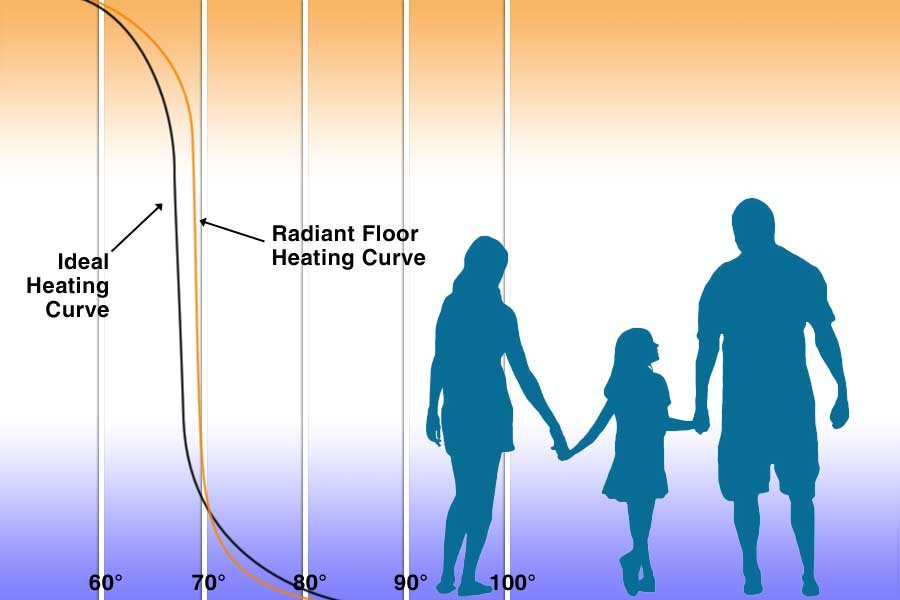
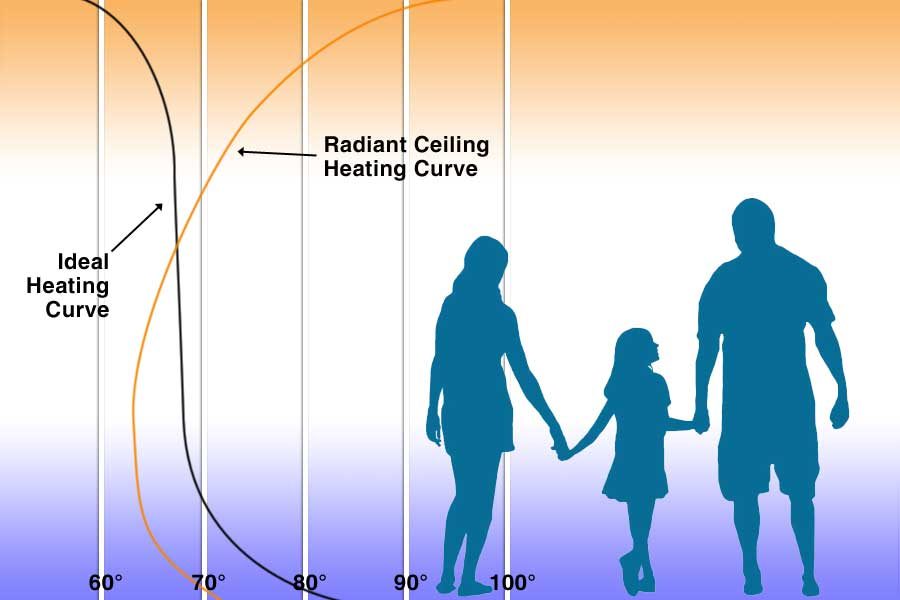
People are most comfortable with 65–68°F at head height and warmer air at the floor. Forced air does the opposite, piling heat at the ceiling. Radiant floors come closest to the ideal, and radiant ceilings come close too.
Warm feet, cool head
Studies of comfort and performance put the ideal temperature at 65° to 68°F around your head and shoulders, with the floor warmer, around 82° to 85°F. Your feet are farthest from your heart and the hardest part of you to keep warm, which is why the old saying holds: warm feet, warm body.
Forced air and baseboards
Forced air typically leaves 75° to 85°F at head height and only 62° to 65°F at the floor: cold feet and a hot head. Hot air collects at the ceiling, where it dries eyes, noses and throats and escapes the building. The gap between the forced-air curve and the ideal curve is wasted energy.
Baseboards and radiators behave much the same way, sending a current of warm air up the outside walls and across the ceiling.
Radiant ceilings and floors
A radiant ceiling brings the temperature at head height much closer to the ideal and raises the floor into the mid-70s. Radiant floor heat comes as close to the ideal curve as any system can. With less heat at the ceiling, less heat is lost through it, and operating costs drop.
Both also use the room itself: the floor, walls and furniture absorb the radiant heat and release it as the room cools.
Answer drawn from Premier Energy USA’s blog. Read the original post.
More questions.
See all questions-
Radiant Basics
Why put heat in the ceiling if hot air rises?
Hot air rises, but radiant heat doesn’t. Like sunlight, it travels in straight lines until it reaches the floor, furniture and people, and warms them directly. Those warmed surfaces then help heat the room. -
Radiant Basics
How does a radiant ceiling compare with baseboard heat?
Baseboards are cheap to buy but cost about three times as much to run in a cold climate. They heat a room from one wall and need 10 to 12 watts per square foot. A radiant ceiling spreads the heat across the whole room, usually at 6 to 8. -
Costs and Efficiency
How efficient is radiant heat, really?
Efficiency percentages are mostly marketing. Real operating costs are a better test: ThermaRay systems typically cost 30% to 60% less to run than forced air, baseboard, hydronic or infrared heat, with no maintenance or replacement.
Have a question of your own?
Call or describe your project, and you'll get a straight answer, with real operating costs from similar buildings.