
Can I heat a floor from below without tearing it up?
The short answer
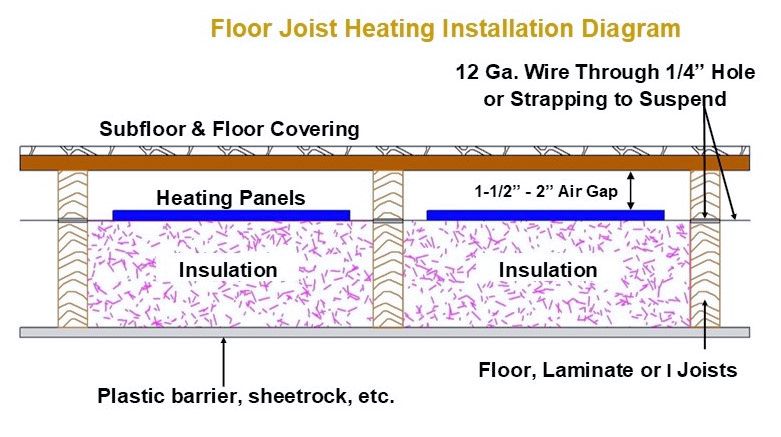
Yes. Floor joist heating hangs radiant panels 1½ to 2 inches below the subfloor, in the joist spaces. It doesn’t raise the floor, isn’t in the wear surface, and the flooring can be changed later without touching it.
How it works
Floor joist heating uses the same panels as a radiant ceiling, wired the same way, but installed 1½ to 2 inches below the subfloor instead of above a ceiling. It works for new construction and under existing floors, as primary or comfort heat.
Unlike a ceiling, where not every cavity needs a panel, a floor should have a panel everywhere you stand or walk. Otherwise you’ll feel the empty spaces. Panels aren’t needed under cabinets or appliances.
What a quote needs
To estimate a floor joist system, send the room dimensions (a sketch or plans), the direction and on-center spacing of the joists, and where permanent fixtures and appliances sit, such as cabinets, the refrigerator or an island.
Answer drawn from Premier Energy USA’s blog. Read the original post.
More questions.
See all questions-
Choosing and Installing
Won’t a radiant ceiling lose heat through the roof?
Not if the ceiling is insulated properly. Drywall has a very low R-value, and the radiant energy passes right through it, while the insulation above sends the heat down into the room. On a cold day, a thermal camera in the attic shows no heat coming through. -
Choosing and Installing
What’s the best way to heat a garage or shop?
There are three ThermaRay options. Thermal mass panels go under a new slab. Radiant ceiling panels hide above the ceiling, new or existing. Architectural Series metal heaters mount on or hang from the ceiling where you can see them. -
Choosing and Installing
Can I add radiant ceiling heat to an existing home?
Yes. With attic access, the panels go above the existing ceiling. Without it, furring strips go on the existing ceiling, the panels go between them, and new drywall covers everything.
Have a question of your own?
Call or describe your project, and you'll get a straight answer, with real operating costs from similar buildings.