
How efficient is radiant heat, really?
Asked by a prospective client
The short answer
Efficiency percentages are mostly marketing. Real operating costs are a better test: ThermaRay systems typically cost 30% to 60% less to run than forced air, baseboard, hydronic or infrared heat, with no maintenance or replacement.
Be skeptical of efficiency claims
Every manufacturer claims high efficiency. Baseboards and furnaces claim 75% to 90% or more, air-source heat pumps 200% to 300%, and some ground-source heat pump makers now claim 600%. ThermaRay systems have matched or beaten ground-source heat pumps in real buildings, but a 600% figure doesn’t mean much.
A Department of Energy study with the National Association of Home Builders found ThermaRay radiant ceilings 52% more efficient than baseboards and 33% more efficient than air-source heat pumps. Even that number is less useful than real bills, because most heat-loss software doesn’t model radiant heat well and ignores thermal mass entirely.
Real operating costs instead
Operating cost estimates vary with the building, the climate and how the space is used, so the most honest answer is actual data from similar buildings in similar or tougher climates. As a rule of thumb, ThermaRay systems cost 30% to 60% less to run than natural gas, electric or propane forced air, baseboard, hydronic or infrared systems. Even if the costs were the same, there’s no maintenance, repair or eventual replacement.
In 2003, Premier Energy USA built a 76 × 100 foot (7,600 sq ft) building with thermal mass floor heat and tracked its usage for years. The heating bill never topped $1,300 for a whole season. Similar buildings in the same complex with forced air cost about three times as much, and one cost five times as much.
A 104,000 square foot example
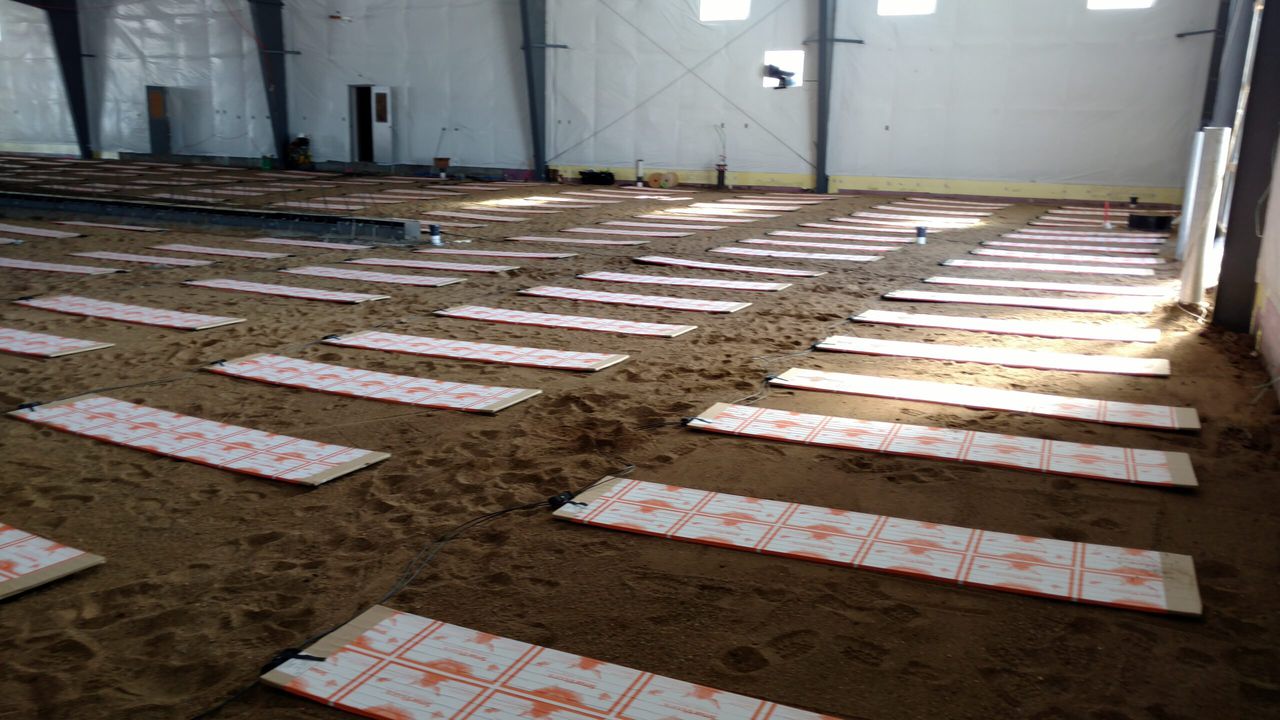
Before building its 104,000 sq ft plant, Design Ready Controls paid an engineering firm $27,000 for a 42-page report. The report put thermal mass floor heat, natural gas rooftop units and a hydronic tubing system at about the same cost to run: around $96,000 a year.
Premier Energy USA said it could heat the building for under $30,000 a year. The first season, 2015–2016, cost less than $16,000 (starting in December). 2016–2017 came in around $23,000, and even the hard winter of 2017–2018 stayed under $30,000. Against the report’s estimate, the savings are now about $500,000.
Answer drawn from Premier Energy USA’s blog. Read the original post 1 · original post 2 · original post 3.
Watch it.
More questions.
See all questions-
Costs and Efficiency
Why doesn’t thermal mass floor heat need insulation underneath?
Heat only moves toward something colder. The panels warm the slab and ground until it reaches the earth’s temperature, about 2 to 2½ feet down, and then stop. That deep mass stores heat, and the bigger it is, the lower the operating cost. -
Costs and Efficiency
Does thermal mass floor heat work in large buildings?
It works better. A 1,200 sq ft building may need 10 to 12 watts per square foot, while a 100,000 sq ft building typically needs 5 to 8. High walls, lots of glass and dock doors are hard for forced air, but radiant heat only has to warm the bottom 6 feet, where people are. -
Costs and Efficiency
In a cold climate, should I spend more on heating or cooling?
Heating. In colder climates homes heat about ten times more than they cool. A radiant ceiling typically costs half as much to run as gas forced air and a third less than electric forced air, so pair it with simple, well-placed AC.
Have a question of your own?
Call or describe your project, and you'll get a straight answer, with real operating costs from similar buildings.