
Won’t a radiant ceiling lose heat through the roof?
Asked by Eric, adding a small shop in Durango, Colorado
The short answer
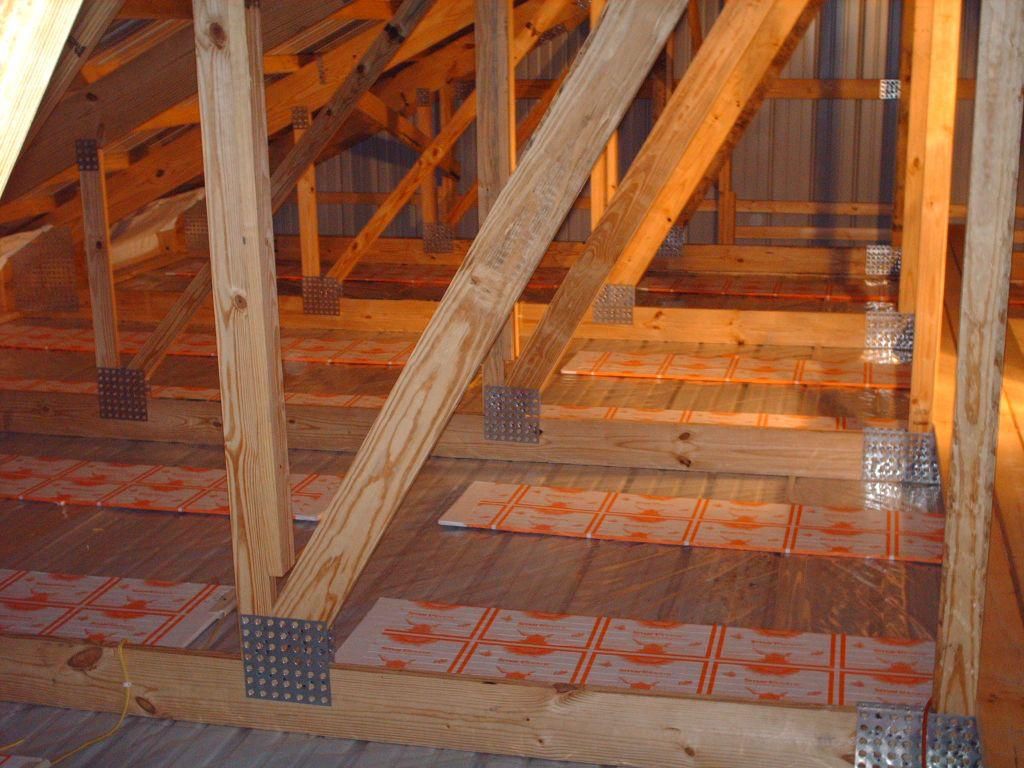
Not if the ceiling is insulated properly. Drywall has a very low R-value, and the radiant energy passes right through it, while the insulation above sends the heat down into the room. On a cold day, a thermal camera in the attic shows no heat coming through.
The conversation
“I am adding a ~220 sqft shop to the side of my residential detached garage … I don’t want any heater taking up wall space, so ceiling/radiant makes the most sense to me. … How is it justified to put the Thermaray panels behind the sheetrock? Sheetrock is an insulator. … Even with 12″ of fiberglass insulation between the joists, it seems that a lot of heat would be lost in an upward direction.”
This is one of the most common installations. Drywall does have an R-value, but it’s very low, and the radiant energy passes through it easily. Two layers of 5/8-inch drywall are common, and the panels also go above ½- to ¾-inch wood ceilings, which insulate even more. With the ceiling insulated properly, no heat is lost through the roof: the insulation directs it into the room. Take a thermal camera into the attic on the coldest day of winter and you won’t see heat coming through. Some of these systems have run for more than 40 years.
The slab was already poured, so the ceiling system it is. The space is 15 × 12 feet, joists on 24-inch centers, at 7,000 feet elevation, where it had just hit −4°F. Two windows, an 8-foot garage door, and a separate thermostat for the shop.
A proposal and rough layout went back the next day, using 18-inch by 5-foot panels: 1,920 watts in all.
“I’m a little surprised we need 1,920 watts. … Other calcs I’ve made myself make me think I’d only need 1,400 to 1,500 watts.” Is it OK to mount an LED shop light under a heat panel?
The rule of thumb is 6 to 8 watts per square foot for a normal room, so those calculations were close. But a small space with three cold walls is harder to heat than a big one, garage doors have a low R-value even when insulated, and the layout doesn’t count on heat from the main garage. Dropping a panel or two is fine if he prefers. LED lights don’t affect the heat, but a fixture mounted directly on the drywall under a panel may wear out sooner. A little space between them is fine.
What clearance do storage shelves need below the ceiling?
The drywall surface only reaches about 105 to 110°F, far less than an old recessed can light. Six to twelve inches of clearance is plenty, the same as kitchen cabinets.
Eric ordered the system.
Answer drawn from Premier Energy USA’s blog. Read the original post.
Watch it.
More questions.
See all questions-
Choosing and Installing
What’s the best way to heat a garage or shop?
There are three ThermaRay options. Thermal mass panels go under a new slab. Radiant ceiling panels hide above the ceiling, new or existing. Architectural Series metal heaters mount on or hang from the ceiling where you can see them. -
Choosing and Installing
Can I add radiant ceiling heat to an existing home?
Yes. With attic access, the panels go above the existing ceiling. Without it, furring strips go on the existing ceiling, the panels go between them, and new drywall covers everything. -
Choosing and Installing
Can I heat a floor from below without tearing it up?
Yes. Floor joist heating hangs radiant panels 1½ to 2 inches below the subfloor, in the joist spaces. It doesn’t raise the floor, isn’t in the wear surface, and the flooring can be changed later without touching it.
Have a question of your own?
Call or describe your project, and you'll get a straight answer, with real operating costs from similar buildings.